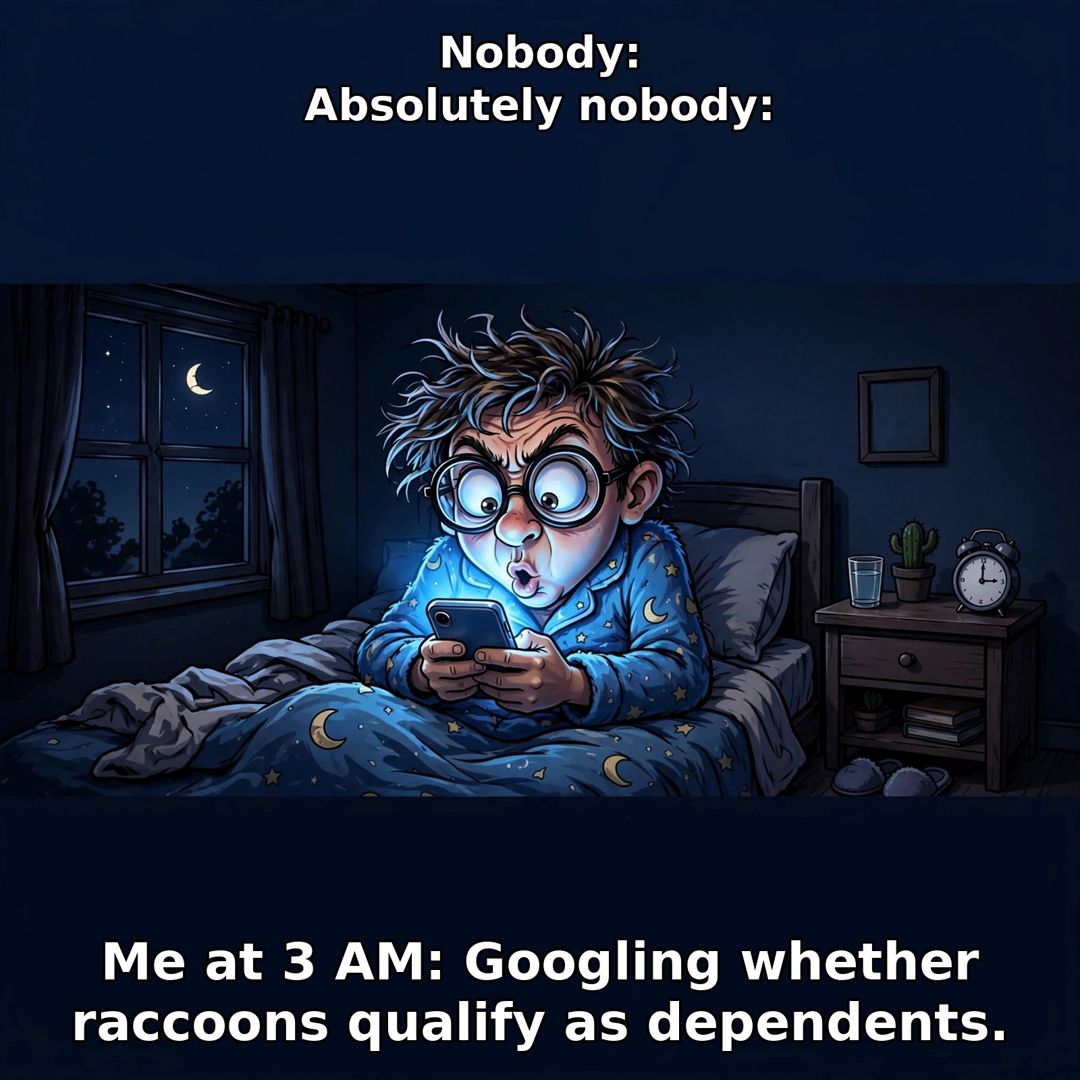
The 3 AM Brain
Nobody. Absolutely nobody. Me at 3 AM, lit only by phone glow, pupils like a nocturnal gremlin: Googling whether raccoons qualify as tax dependents. This is the kind of question that feels earth-shatteringly urgent at 3 AM and completely insane by 9 AM, and yet here we are, three search results deep, learning things about IRS Publication 501 that no one was meant to know.
The 3 AM brain is a special instrument. It doesn't do priorities. It does rabbit holes. It takes one idle thought — "that raccoon in the yard sure eats a lot of my trash, which I paid for" — and turns it into a full research project with citations. By 3:30, I've got seventeen tabs open and a working theory.
The Case for the Raccoon
Let's examine the merits. The raccoon lives on my property. I provide its food — indirectly, via the trash can, but the trash service isn't free. It is arguably a dependent in the emotional sense; I worry about it. I've named it. You don't name something you don't care about. The IRS has rules about this. Probably. I haven't gotten that far in the tabs yet.
Counterpoint: the raccoon has never once contributed to the household. It pays no rent. It knocked over the recycling bin twice this month. Its only job is being adorable at a distance, and while it excels at that job, I'm not sure the IRS accepts "adorable at a distance" as qualifying criteria.
Extremely Deductible in Cuteness
The things that feel urgent at 3 AM are never the things that are actually urgent. My taxes aren't due for months. The raccoon is asleep. The only thing I've accomplished is a search history that would confuse a forensic accountant.
But the raccoon remains extremely deductible in cuteness, and that's worth something. Not to the IRS. To me. At 3 AM. Which is the only jurisdiction that matters right now. Goodnight.
Building the Case
Let's review the evidence objectively, as any 3 AM legal mind would. Exhibit A: the raccoon lives on the property. Exhibit B: the raccoon is fed regularly — or rather, feeds itself regularly from a trash can the household maintains at considerable expense. Exhibit C: the raccoon provides emotional support, specifically the emotion of "delighted horror" every time it appears on the Ring camera standing upright like a tiny burglar.
Exhibit D, and this is the strong one: the raccoon has never once contributed to household income, yet consumes household resources daily. If that doesn't meet the textbook definition of a dependent, the textbook needs a new chapter. The 3 AM brain rests its case. The 3 AM brain is extremely confident and will be extremely embarrassed about this by 9 AM.
The Audit Scenario
Of course, every great 3 AM plan must survive contact with daylight, so let's game out the audit. "Sir, you claimed a raccoon." "A dependent, yes." "Sir, raccoons are wildlife." "He has a name. It's Gerald." "You named the raccoon Gerald." "He responds to it. That's practically documentation." At this point in the fantasy, the auditor removes his glasses and pinches the bridge of his nose, and honestly, that's a win. Any meeting that ends with the auditor pinching his nose is a meeting you dominated.
The search history was cleared. The raccoon remains unclaimed, living his best untaxed life in the storm drain. But somewhere in a government database, there's a flagged query — "raccoon dependent IRS" — and a very tired analyst who has decided not to think about it too hard. Smart analyst. Some questions are better left unasked at any hour.